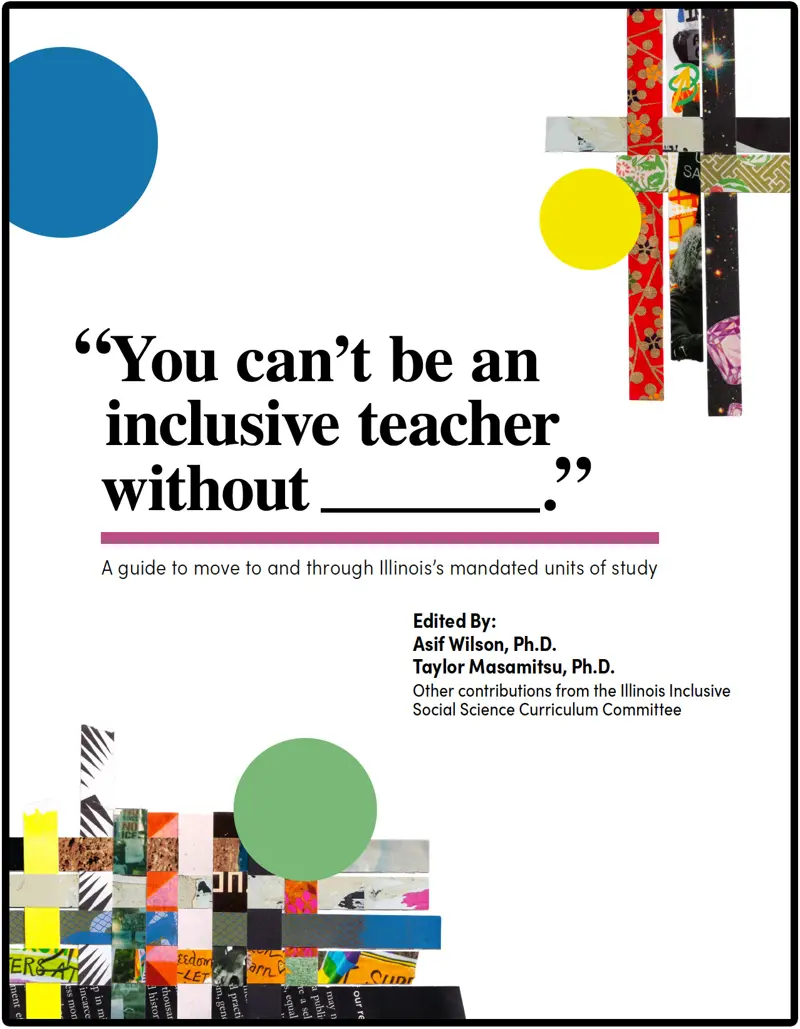
“You can’t be an inclusive teacher without .”
A guide to move to and through Illinois’s mandated units of study
The Work We Weave
Weaving often refers to a storied form of fabric making that entails interlacing elements to create visual and/or textual designs (Greenfield, 2004).
Over the years, people across the globe have come to think about weaving as a creative and interpersonal practice, one through which weavers combine cultural traditions, intergenerational knowledge, and individual emotions to create meaningful pieces of visual art (Maynard et al., 2024). This powerful understanding of weaving has also taken root in conversations about education.
Recently, we’ve been invited to think about weaving (or braiding) as a metaphor for “a different mode of teaching and learning, [as] a lens for reflecting on the ways we are connected to one another and as a practice that teaches us something about how we can be teachers and learners in the community” (Ewing, 2025, p. 265).

“...no history/herstory/theirstory exists in a silo, and social studies belongs to us all.

About the Framework
Illinois state lawmakers have authored, voted on, and passed these mandates for over 20 years—often working with community members and advocates to do so. Today, these mandates require that K–12 educators teach racial, ethnic, religious, women’s, LGBT+, disability, and labor histories/herstories/theirstories.
In this framework, “You can’t be an inclusive teacher without: ____,” we weave together Illinois’s Mandated Units of Study for Social Science into interconnected and intersecting themes of knowledge and action. We made this because we acknowledge that some of these mandates might seem to exist as isolated content areas. And yet, no history/herstory/theirstory exists in a silo, and social studies belongs to us all.
A team of teachers, administrators, and scholars from Illinois and the broader United States created this framework. This team included experts in K–12 education and the content areas relevant to Illinois’s inclusive history mandates.
This project was funded by the Illinois State Board of Education.


How Is This Framework Organized?
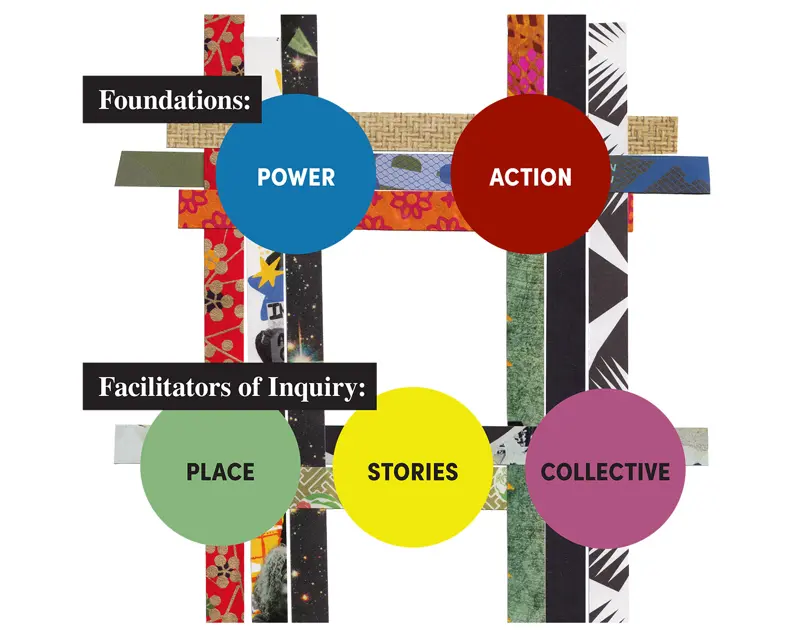
Power and action represent the framework’s “foundations,” or the understandings
and commitments that support each Mandated Unit of Study in Illinois. Place,
stories, and collective are “facilitators of inquiry,” which provide content, concepts,
and methods to help teachers facilitate inquiry-based teaching and learning
across the mandates.
For each "big idea" we provide:
- Definition
- Narrative explanation
- Real-life classroom example
- Ideas and resources for implementation
Classroom-Focused
Included in the framework are stories that come from real teachers’ experiences, which we represent as interviews and personal reflections. Each section ends with ways to support teachers in transferring the concept to their respective settings (e.g., “Bringing this Big Idea into Your Classroom”), including linked resources to learn more and work toward implementation.
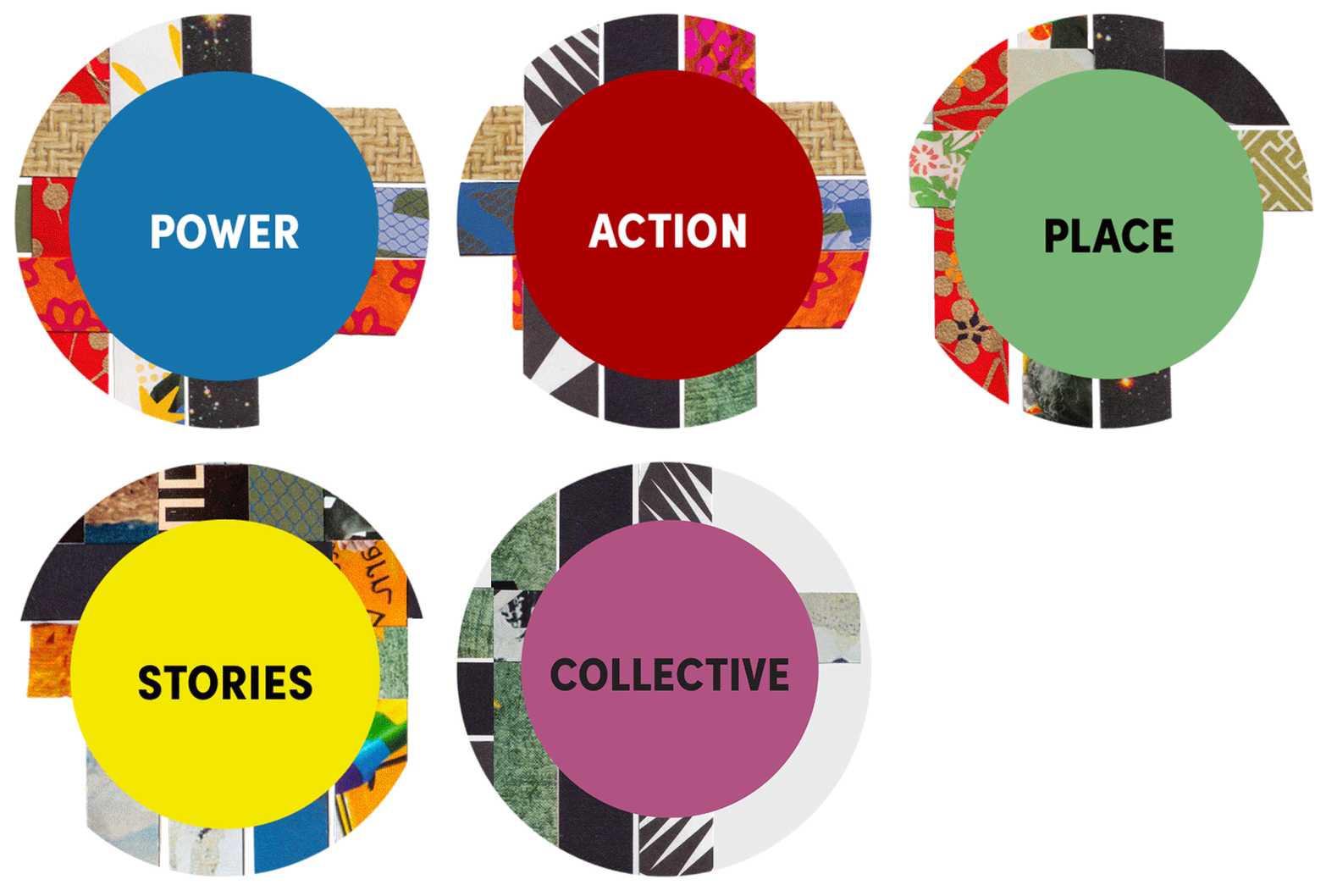
The Framework's 5 Big Ideas:
What Is Power?
Power is a system that shapes who has control, whose perspectives are recognized, and how domination, oppression, and resistance operate across time.
What Is Action?
Action is a sincere and ongoing commitment to dismantling harm—specifically harms grounded in white supremacist and colonial thinking and actions that have long informed how people navigate the U.S. and much of the world. In this framework, we conceptualize action as four interrelated elements:
critical self-reflection;
establishing mutual, respective vulnerability and openness;
world building that values, engages, and develops with the strengths and brilliance of students and their communities; and
inquiry as action, where young people ask questions, adults learn from young people, and relationships in communities are grown.
What Is Place
Place includes all our natural and constructed environments, as well as the humans and other living beings making and remaking them. The past, present, and future all take form in physical places. Places also hold deep political, spiritual, and social importance. As the birthplaces and homelands of people and societies, places make us who we are.
What Are Stories?
Stories connect and expand ways of knowing, learning, being, and living—inviting connections across past, present, and future. Recognizing and centering stories, or the practice of storying, requires challenging dominant narratives to disrupt settler colonial norms and build honorable relationships among peoples and lands. Centering stories holds the potential to cultivate perspective-taking, reflection, coalition-building, and global learning.
What is Collective?
Collective reflects the ways communities have moved together to preserve knowledge, challenge injustice, and imagine different futures. In the classroom, collective invites students and teachers to experience learning as a shared responsibility rooted in relationships, stories, community, and the ongoing struggle for justice.

Download The Complete Framework
Edited By:
Asif Wilson, Ph.D.
Taylor Masamitsu, Ph.D.
Other contributions from the Illinois Inclusive Social Science Curriculum Committee
Are we creating spaces for students to ask urgent questions, analyze power, and communicate with real audiences...?
