Pilot testing of the asynchronous i3 course, conducted with 27 Illinois educators, found:
“The asynchronous i3 experience offers more flexibility, allowing me to work through the content of my own pace and revisit materials when needed. The asynchronous experience requires more self direction and ownership…providing meaningful opportunities for reflection and learning”
i3 Series Overview
i3 is a 4-month long asynchronous learning experience designed to transform Illinois social studies educators’ practice towards inquiry- and justice-centered learning. More specifically, i3 supports teachers' preparation to meet the standards within the Illinois Mandated Units of Study for Social Science and the Illinois Learning Standards for Social Science.
i3 is guided by one essential question: What immediate and long-term curricular, pedagogical, and spatial actions will I take to center justice and inquiry in my classroom or school?
This question is answered over five self-paced modules that are guided by a process of inquiry-to-action. i3 places participants in the driver's seat--modeling inquiry, inclusion, and action as learners through experiences that require participating educators to inquire and act.

Module 1: How can I enact inquiry in my classroom?
This module invites participants to develop an understanding of existing frameworks for inquiry and build a clearer vision for what justice-centered inquiry looks like in practice.
Participants will…
Examine the C3 Framework and Illinois Learning Standards for Social Science Inquiry Skills
Reflect on their current inquiry-based teaching and learning practices
Participate in an inquiry-design studio collaborative workshop
Module 2: How will I foster inclusion in my classroom?
This module guides participants through deep consideration of their personal identities and biases. Beginning with self-reflection creates opportunities for educators to better understand the importance of inclusion in the classroom and move towards justice-centered teaching and learning practices.
Participants will…
Analyze the Illinois Mandated Units of Study for Social Science and the degree to which they are being satisfied in your curriculum.
Examine how centering inclusion and justice in tandem with inquiry can better respond to the local communities you serve.
Explore curricular and instructional practices to determine how inquiry can be utilized to foster more inclusive, justice-centered learning experiences.
Module 3: What actions will I take to center inquiry and inclusion in my classroom today?
This module supports participants in designing their own Action Plans. Action planning enables educators to identify and create concrete steps towards inclusive and justice-centered social studies education.
Participants will…
Analyze the role of action and civic engagement within justice-centered, inquiry-based social studies classrooms and schools.
Identify obstacles to enacting inquiry and explore strategies to move beyond them.
Design action steps to advance inquiry in pedagogical, curricular, and spatial forms.
Module 4: How will I build and engage a squad to strengthen my inquiry-based and justice-centered practice?
This module emphasizes feedback and community as central aspects of inquiry-based teaching and learning. Participants are invited to solicit, reflect on, and implement feedback related to their Action Plans with various stakeholders (e.g. students, teachers, admin, community members).
Participants will…
Prepare to receive and thoughtfully respond to feedback from students, colleagues, administrators, and community members.
Revise an action plan based on stakeholder feedback and personal reflection.
Implement a revised action plan and monitor your progress toward identified goals.
Module 5: How will I sustain and continue to grow my practice over time?
This final module invites participants to pause and reflect on their i3 journey, affirm that teaching is an act of care, and consider how they will sustain this vital work over time.
Participants will…
Share and celebrate the work you have developed throughout your i3 journey.
Reflect on your growth and create strategies to address current and future roadblocks to sustaining your practice.
Review the progress you have made across the series and identify the next steps that will carry your inquiry and justice-centered work forward.
Participants who complete 80% or more of all module content and assignments will be eligible for the following:
• ISBE-approved microcredential
• 24 PDH Hours
Resources
Access some of i3’s newest resources below:
Read about i3 in the news: Faculty Viewpoint , Inquire-Ed
For more resources, check out our Social Studies Network Resources page.
What to Expect
Estimated Time Commitment
The series is estimated to take participants 24 hours to complete at a high level. This estimation is broken down by each module as listed below:
| Orientation: | 1 hour and 25 minutes |
| Module 1: | 4 hours and 20 minutes |
| Module 2: | 3 hours and 45 minutes |
| Module 3: | 3 hours |
| Module 4: | 7 hours and 45 minutes |
| Module 5: | 3 hour and 45 minutes |
Keep in Mind: We recommend creating your own timeline that considers the ebbs and flow of your schedule. Give yourself flexibility that considers your personal and professional obligations, enabling you to stay on track and successfully complete the series.
The entire series is self-paced over the duration of four months. Each module is made available with the completion of the previous one. The i3 team suggests spreading the content over the entire 4 month period to allow enough time to fully experience the long-term nature of the series and allow for deeper analysis and reflection. It is important to divide the work up over time as some assignments require several days/weeks to be completed at a high level.
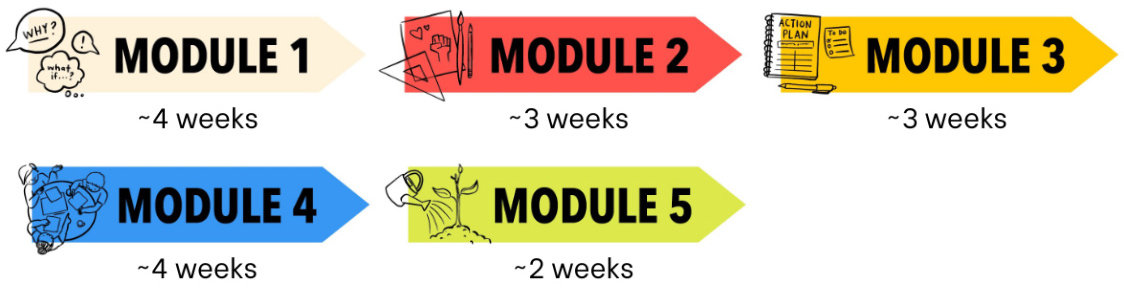
Suggested Pacing Timeline:
| Module 1: | 4 weeks |
| Module 2: | 3 weeks |
| Module 3: | 3 weeks |
| Module 4: | 4 weeks |
| Module 5: | 2 weeks |
Stay Connected with the i3 Community
i3 participants become members of our growing alumni network of over 1,000 Illinois educators. Stay connected on this website and make sure to be registered for the SSN mailing list.
Engagement
Successful engagement in the i3 series looks like:
Completing all readings and assignments
Engaging in thoughtful discussion posts/replies
Enacting inquiry-based and inclusive learning into the classroom
Reflecting thoughtfully on your practice
Embracing the iterative and non-linear nature of inquiry
Participants will be assessed based on the following rubric.